Designing for Human-AI Teaming
Designing AI interactions that users can understand, predict, trust, and learn alongside.

ROle
Lead UX Designer (Research, AI Interaction Design, Evaluation)
TimeLine
10 Weeks
OutCOmes
User Research, Human-AI Teaming (HAT), Prototyping, Usability Testing, Trust Evaluation
MEthods
Validated Human-AI Teaming principles through usability, trust, and collaboration evaluations.
Jump to…
The Challenge
As AI becomes more integrated into everyday work, effective collaboration depends on more than automation alone. Users must be able to understand, predict, trust, and learn alongside AI systems.
This project explored how Human-AI Teaming (HAT) principles could guide the design of an AI teammate within a collaborative project environment. Our work focused on five core principles: Understanding, Predictability, Mutual Trust, Adaptation, and Learning.
HAT PRINCIPALS
Understanding
Can users understand the AI?
Predictability
Can users anticipate its behavior?
Mutual Trust
Can users appropriately trust it?
Adaptation
Can humans and AI adjust to one another?
Learning
Does collaboration improve over time?
1 Evaluation Approach
We evaluated the design against the five Human-AI Teaming principles: Understanding, Predictability, Mutual Trust, Adaptation, and Learning.
participants & Methods
11 participants (6 students, 5 instructors/TAs)
Quantitative evaluation
Qualitative evaluation
Think-aloud protocols
Observation notes
Interviews
Quantitative Metrics
Errors
Failed attempts & misclicks
Capability
System Capability Scale
Trust
Cognitive Trust Scale
Relevance
Relevance Questionnaire
Collaboration
HRI Collaboration Scale
Usability
SUS
2 HAT PRINCIPALS
Understanding
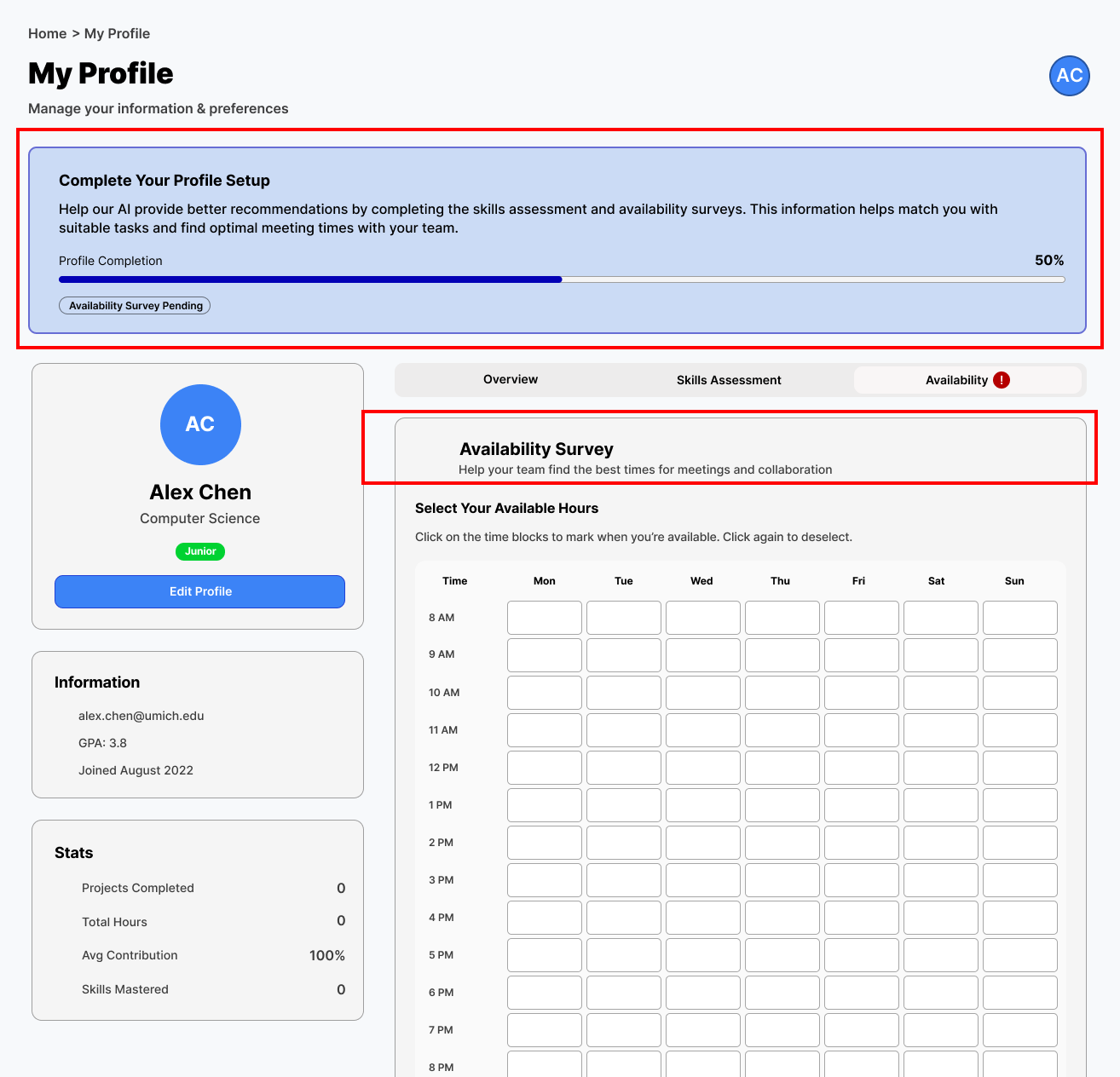
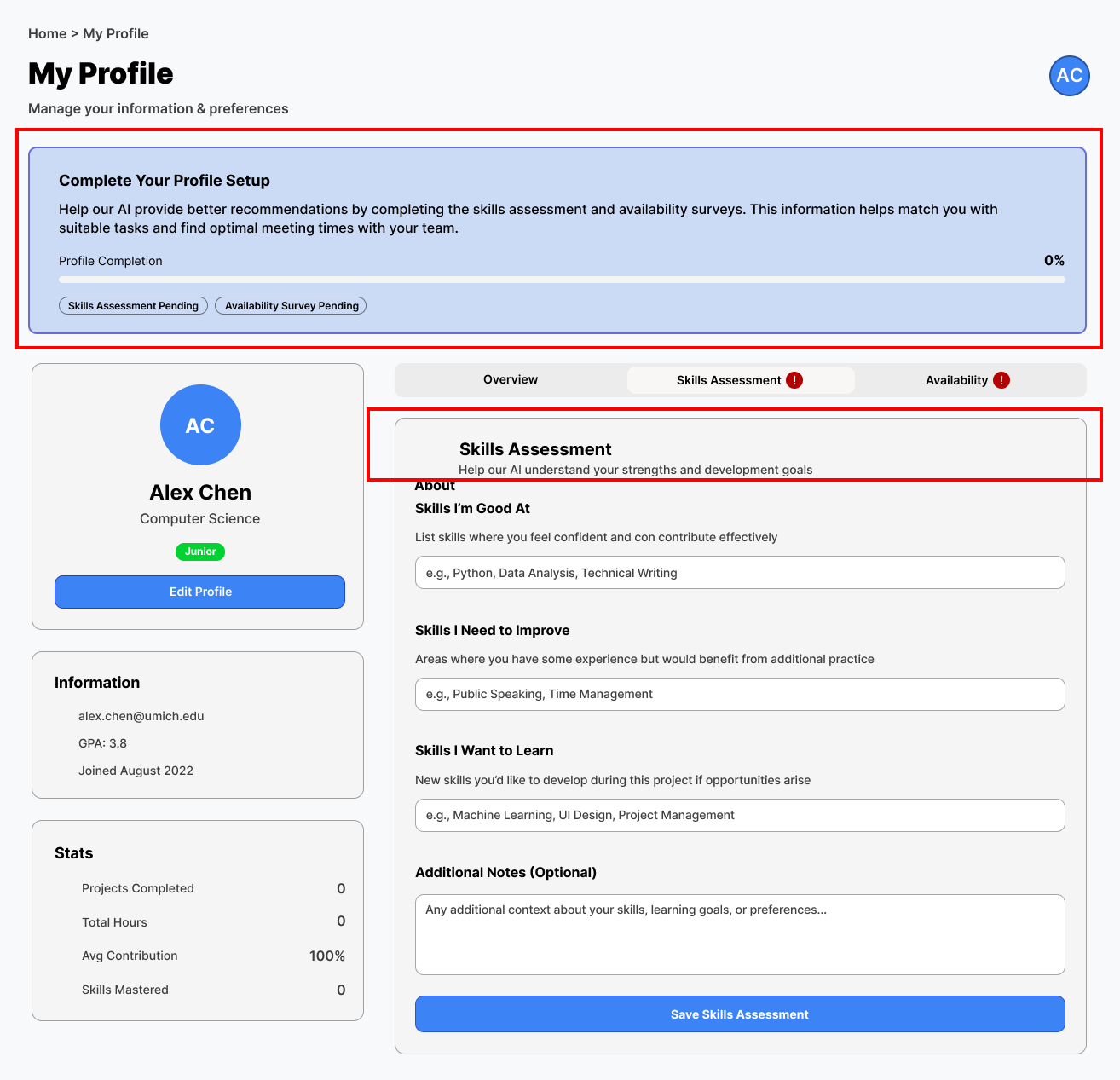
User Requirement: Users needed transparency into how the AI generated recommendations and supported project work.
Design Decision: We designed onboarding to make the AI's decision-making process transparent, clearly showing what information was collected and how it informed future recommendations.
Evaluation Findings: Participants generally understood the AI's purpose and recommendations, supported by strong relevance and comprehension scores.
Ethical Considerations: Users should be able to understand when AI is influencing a recommendation and retain control over final decisions.
Users provide skills, goals, and availability upfront, creating transparency into the information the AI uses to generate recommendations.
Predictability
User Requirement: Users needed consistent and reliable AI behavior so they could anticipate outcomes and confidently incorporate recommendations into their workflow.
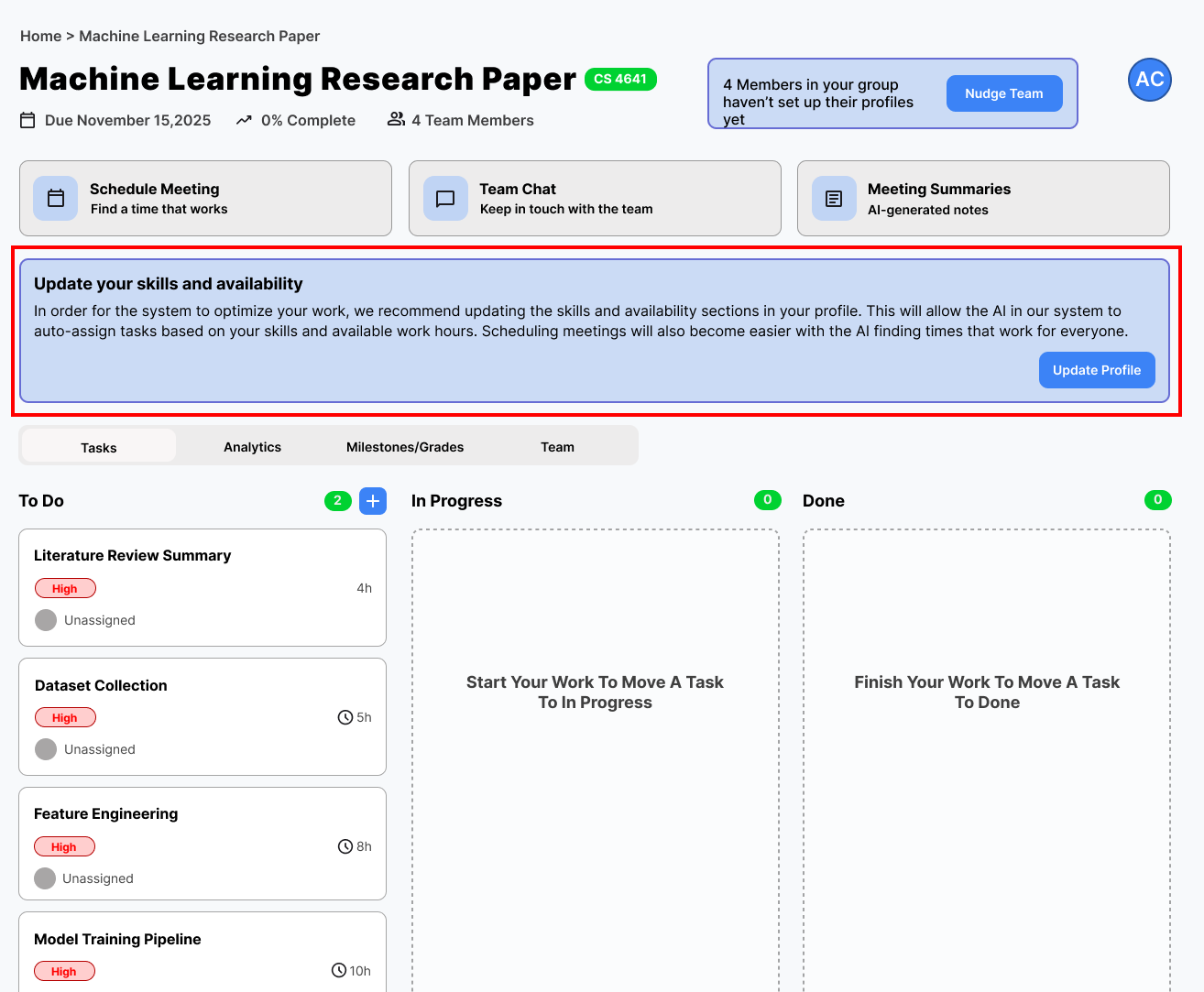
Design Decision: We clearly communicated what information the AI relied on and how it would influence future recommendations, helping users form accurate expectations of system behavior.
Evaluation Findings: Participants generally understood how the AI supported project coordination, though some uncertainty remained during more complex setup tasks.
Ethical Considerations: Users should understand how AI recommendations are generated and be able to anticipate their impact on project decisions.
Clear explanations connect user inputs to AI-generated recommendations, making system behavior more predictable and understandable.
Mutual Trust
User Requirement: Users needed AI recommendations they could trust without feeling that important decisions were being made for them.
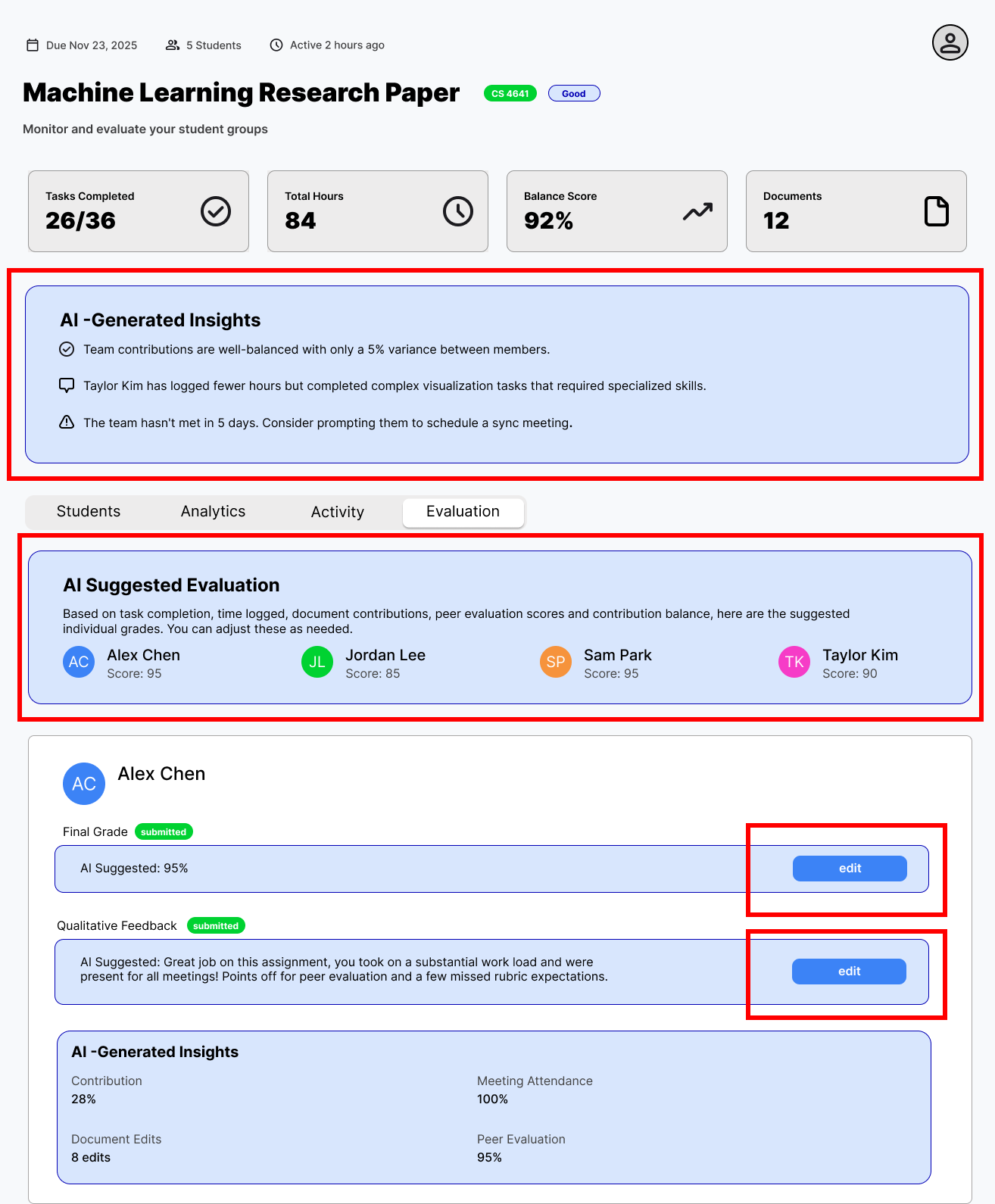
Design Decision: We designed the AI to explain its recommendations, provide supporting evidence, and preserve human oversight by allowing instructors to review and modify all AI-generated evaluations.
Evaluation Findings: Participants reported high trust in the system and viewed the AI as a helpful collaborator rather than an autonomous decision-maker.
Ethical Considerations: High-impact decisions should remain under human control. AI recommendations should be explainable, reviewable, and easily overridden when human judgment differs.
Transparent recommendations and editable outputs help establish trust while preserving human decision-making authority.
Adaptation
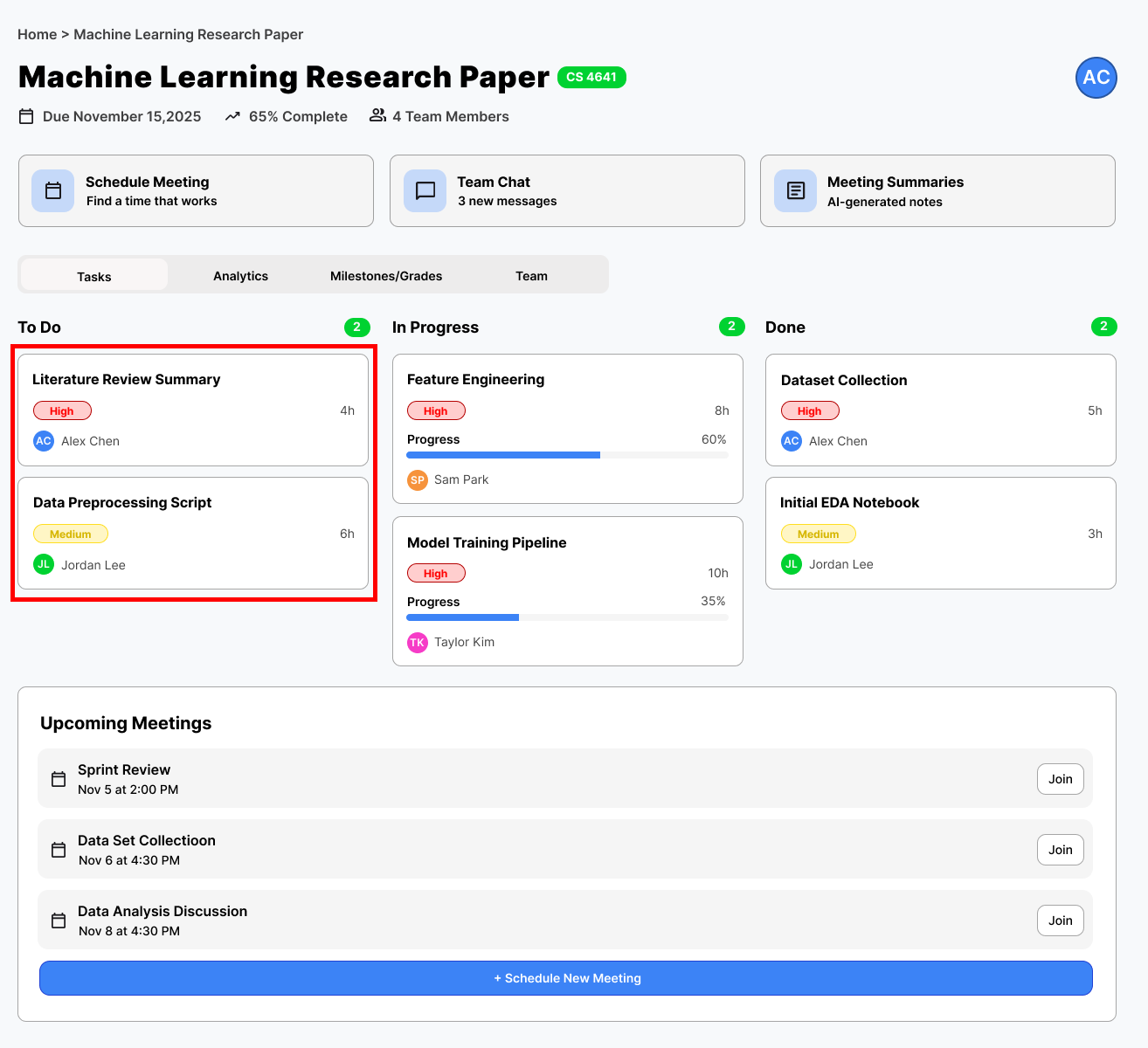
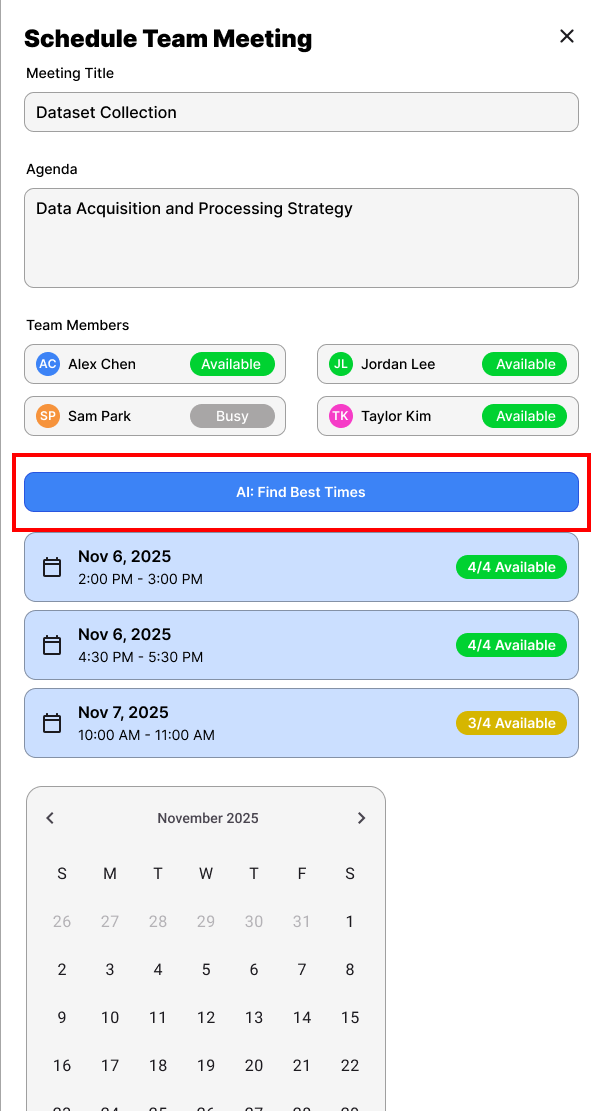
User Requirement: Users expected the AI to provide recommendations that reflected their skills, availability, and project needs rather than offering generic support.
Design Decision: We designed the AI to adapt task assignments and meeting recommendations using information gathered from user profiles, skill assessments, and availability preferences.
Evaluation Findings: Participants found personalized recommendations helpful and relevant, though feedback suggested that future iterations should better account for evolving team dynamics and collaboration patterns.
Ethical Considerations: Adaptive recommendations should be transparent, allowing users to understand what information is being used and ensuring they can override AI-generated suggestions when needed.
The AI adapts to team members' skills and availability, generating personalized task assignments and meeting recommendations that reflect each team's unique needs.
learning
User Requirement: Users expected the AI to continuously learn from project activity and provide increasingly relevant insights as more information became available.
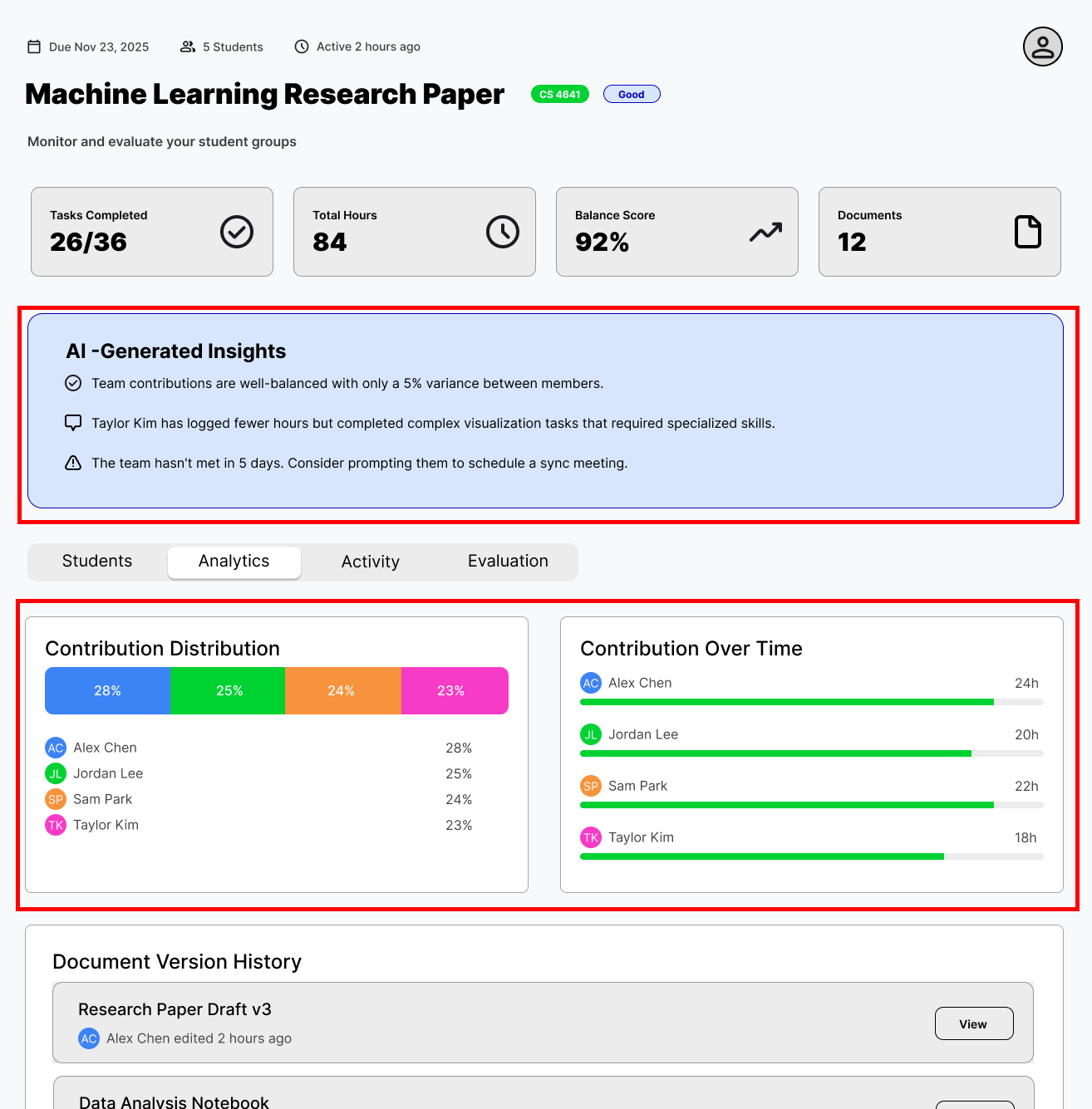
Design Decision: We designed the AI to analyze team contributions, project progress, and collaboration patterns to generate ongoing insights that supported decision-making throughout the project lifecycle.
Evaluation Findings: Participants responded positively to AI-generated insights and found performance analytics useful for understanding team progress and identifying areas requiring attention.
Ethical Considerations: Systems that learn from user behavior should clearly communicate how data is collected and used, while ensuring recommendations remain fair, explainable, and free from unintended bias.
The AI continuously analyzes team activity, contribution patterns, and project progress to generate evolving insights throughout the project lifecycle.
3 Reflection
What I learned
This project taught me how to evaluate AI experiences through a human-centered lens. Rather than focusing solely on functionality, I learned to consider how design decisions influence user understanding, trust, collaboration, and control. The Human-AI Teaming framework gave me a practical way to translate abstract AI ethics and design principles into measurable user experiences.
Biggest Challenge
The biggest challenge was translating abstract Human-AI Teaming principles into concrete design decisions. Concepts such as trust, adaptation, and predictability are easy to discuss theoretically but difficult to represent through interface design. Balancing AI assistance with human autonomy required continual refinement to ensure the system felt collaborative rather than automated.